
An experimental approach to Mathematics
Today I read an interesting article that I am delighted to share with you.
Today I read an interesting article that I am delighted to share with you. These thoughts are written by a prominent (Argentine-American) computer scientist - Gregory Chaitin. It is published by Inference Review:
- G. Chaitin. Doing Mathematics Differently, Inference Review, 2(1), 2016
It is devoted to Author's baby - the Algorithmic Information Theory (AIT). The issues discussed there should be of interest for any working mathematician. Perhaps, this is my favourite passage from the aforementioned article:
What if we take Gödel incompleteness very seriously and throw away rigor? Suppose you have a property of the prime numbers which has been checked on the computer. You graph it and there is a beautiful curve, and it is fit beautifully by a very simple equation. What if you cannot prove it? A physicist would publish anyway. But a pure mathematician does not care how much empirical evidence there is, or how accurately this simple formula fits the curve. You need a proof!
This post first appeared on my former blog, dutykh.github.io, on 9 February 2016.
Dr. Denys Dutykh
Khalifa University of Science and Technology, Abu Dhabi, UAE
Related Posts

Applied mathematics has met the machine before
The long version of my guest essay for Proofs and Prompts, published there on 28 September 2026.

Interim Guidance on the Use of AI Tools in Postgraduate Studies and Research
Interim guidance sent to the postgraduate students of our College on using AI tools in coursework, research and the thesis, written in the week of the Navier–Stokes announcement.
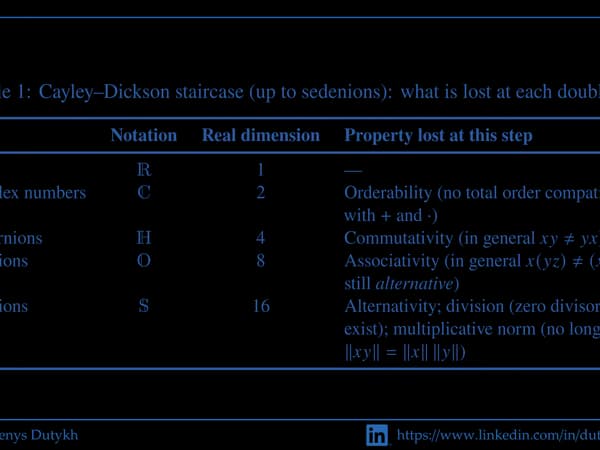
The Cayley–Dickson Staircase: What Each Doubling Costs
The Cayley–Dickson staircase is usually presented as far as the octonions. One step further, at the sedenions of real dimension 16, alternativity, division and the multiplicative norm all fall at once.