
The Trace of a Matrix: A Dual and Tensor Perspective
A fresh look at the trace of a square matrix: its linearity, role in the dual space of operators, unique tensor characterization, and its connection to inner products and the transpose via the dual.
The main result
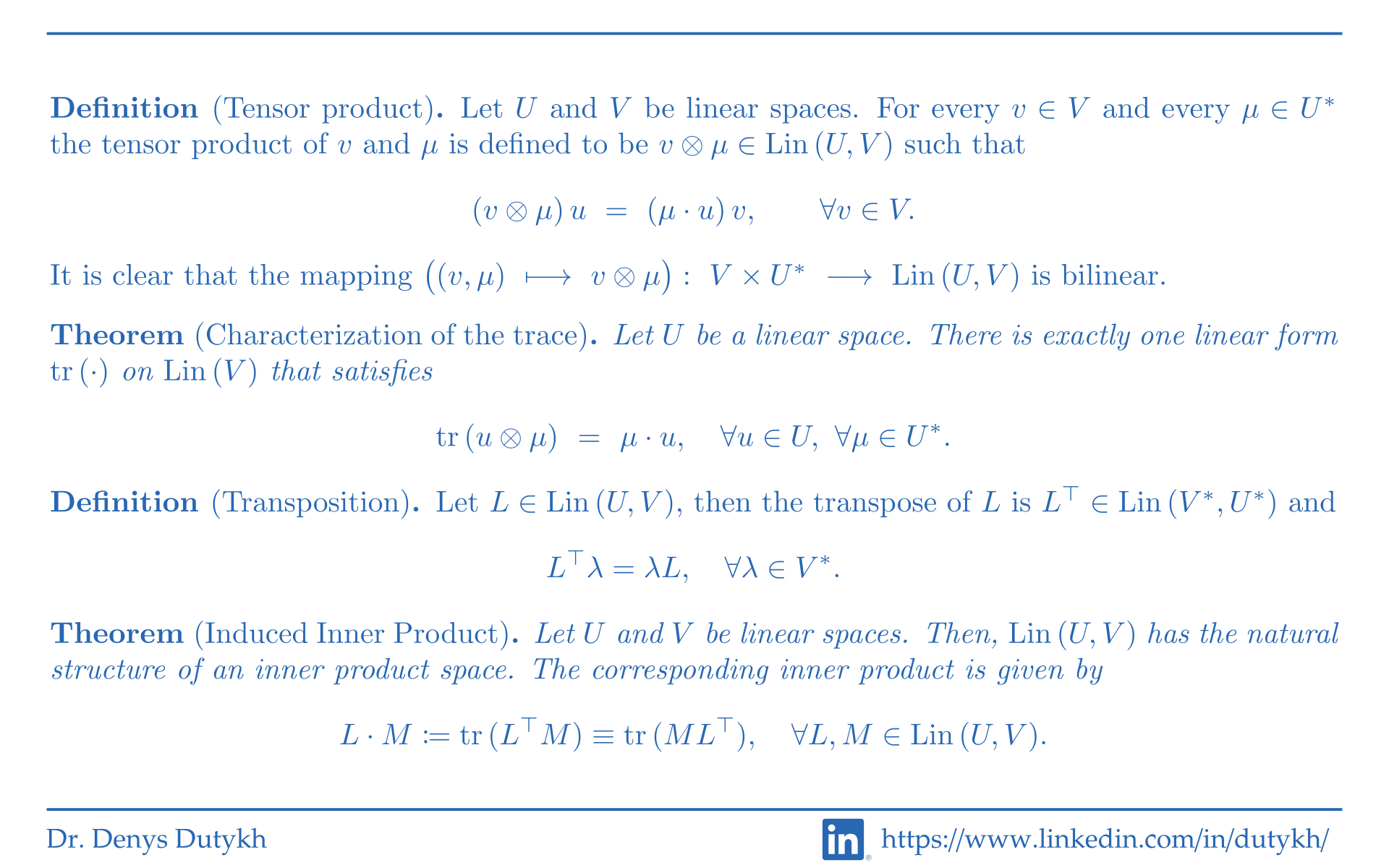
Dear Reader, in today's brief, we will discuss the trace of a square matrix. Let us try to have a slightly different perspective on this familiar object, which takes a square matrix (thus, a linear operator) and returns a number of the same type as matrix elements. First, one can notice that this function is linear. Hence, it belongs to the dual vector space of linear operators. It turns out that the trace has a pretty unique characterization in terms of the tensor product operation. Moreover, the trace allows us to glorify the space of linear transformations to the inner product space. On our way, we define properly the transpose of a linear operator, which must pass by the dual, a fact too often omitted in standard linear algebra courses. Some details of this brief story can be found in the slide below for your reflection, meditation, and enjoyment.
Dr. Denys Dutykh
Associate Professor of Mathematics
Khalifa University of Science and Technology, Abu Dhabi, UAE
Related Posts

From Gauss–Lucas to de Bruijn–Springer
Gauss–Lucas puts the roots of the derivative inside the convex hull of the roots. De Bruijn and Springer conjectured in 1948 that they are pulled inward on average — it took 55 years and two proofs.

Applied mathematics has met the machine before
The long version of my guest essay for Proofs and Prompts, published there on 28 September 2026.

Interim Guidance on the Use of AI Tools in Postgraduate Studies and Research
Interim guidance sent to the postgraduate students of our College on using AI tools in coursework, research and the thesis, written in the week of the Navier–Stokes announcement.