
Optimal hunting group size
As you probably already understood, my traditional research interests are focused on various questions stemming from the Hydrodynamics and free surface flow simulation.
As you probably already understood, my traditional research interests are focused on various questions stemming from the Hydrodynamics and free surface flow simulation. However, recently I opened a new research direction (at least for me) of mathematical modelling of animal behaviour. More precisely, we model the hunting process of a prey (e.g. an elk or a bison) by a group of wolves. It is quite well described by the laws of classical Mechanics.
In our first study we explain on the language of Dynamical Systems why there is an optimal hunting group size which maximizes the probability of prey's capture. These results have been recently described in a succinct way in this manuscript:
- R. Escobedo, D. Dutykh, C. Muro, L. Spector & R.P. Coppinger. Group Size Effect on the Success of Wolves Hunting, Submitted, 2015
I would like to express my grattitude to Ramond Escobedo who brought me into this true scientific adventure!
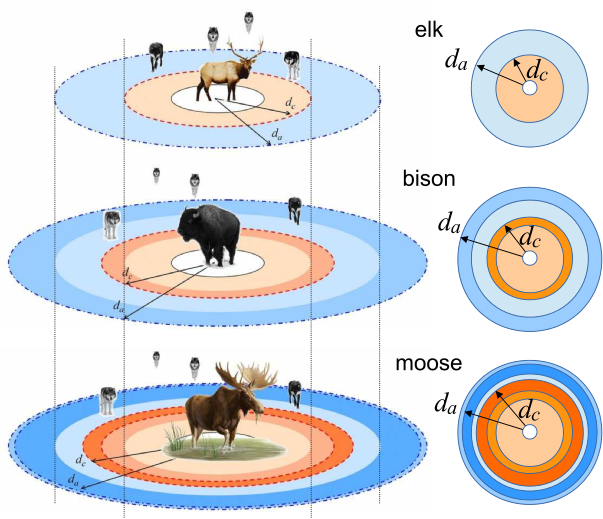
This is the summary of our first common work:
Social foraging shows unexpected features such as the existence of an optimal group size above which additional individuals do not favor the success of the hunt. Previous work shows that the optimal group size is surprisingly small. In wolves hunting elk in Yellowstone Park, hunting success levels off beyond pack sizes of 4 individuals. This observation recently received support from a computational agent model which showed that the reduction of hunting success in large packs can be due to the emergence of privileged positions in the spatial wolf-pack formation. Subsequent observations of wolves hunting bison reinforce and document the hypothesis of the privileged positions. When hunting bison, the optimal wolf-pack size is between 9 and 13. We show here that this is in accordance with the computational model. Moreover, although the optimal group size is expected to be greater when hunting more dangerous prey, we show that this relation is surprisingly not linear: the computational model reveals that the optimal group size actually results from the opposite contributions of two critical distances separating wolves and prey. These distances strongly depend on the kind of prey, and can induce a different variation if a different prey is considered (e.g. moose).
This post first appeared on my former blog, dutykh.github.io, on 5 July 2015.
Dr. Denys Dutykh
Khalifa University of Science and Technology, Abu Dhabi, UAE