
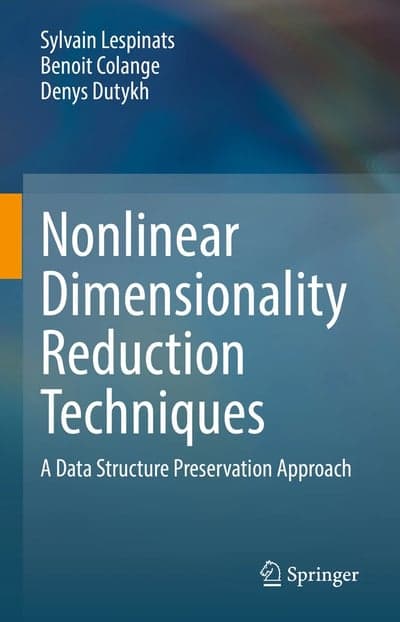
Nonlinear Dimensionality Reduction Techniques
A Data Structure Preservation Approach
Authors
S. Lespinats, B. Colange and D. Dutykh
Year
2022
Pages
XLIII, 247
ISBN
Softcover: 978-3-030-81028-3
Hardcover: 978-3-030-81025-2
eBook: 978-3-030-81026-9
Publisher
Springer International Publishing
DOI
https://doi.org/10.1007/978-3-030-81026-9
Subjects
Machine Learning › Data Structures and Information Theory › Artificial Intelligence › Computer Imaging, Vision, Pattern Recognition and Graphics › Signal, Image and Speech Processing
Key Features
- •Reviews state-of-the-art methods in dimensionality reduction techniques, written in a clear but precise mathematical language
- •Presents application of the methods to the representation of expert-designed fault indicators for smart buildings, I-V curves for photovoltaic systems and acoustic signals for Li-ion batteries
- •Numerous appendices provide mathematical background to facilitate the understanding of the main text
100 illustrations(12 b/w, 88 color)
Abstract
This book proposes tools for analysis of multidimensional and metric data, by establishing a state-of-the-art of the existing solutions and developing new ones. It mainly focuses on visual exploration of these data by a human analyst, relying on a 2D or 3D scatter plot display obtained through Dimensionality Reduction. Performing diagnosis of an energy system requires identifying relations between observed monitoring variables and the associated internal state of the system. Dimensionality reduction, which allows to represent visually a multidimensional dataset, constitutes a promising tool to help domain experts to analyse these relations. This book reviews existing techniques for visual data exploration and dimensionality reduction such as tSNE and Isomap, and proposes new solutions to challenges in that field. In particular, it presents the new unsupervised technique ASKI and the supervised methods ClassNeRV and ClassJSE. Moreover, MING, a new approach for local map quality evaluation is also introduced. These methods are then applied to the representation of expert-designed fault indicators for smart-buildings, I-V curves for photovoltaic systems and acoustic signals for Li-ion batteries.
About the Authors
Sylvain LESPINATS, Benoit COLANGE - National Institute of Solar Energy (INES), Grenoble Alpes University, LE BOURGET DU LAC, France. Denys DUTYKH - CNRS - LAMA UMR 5127, Université Grenoble Alpes, Université Savoie Mont Blanc, Campus Scientifique, Le Bourget-du-Lac, France.
How to Cite
Lespinats, S., Colange, B., & Dutykh, D. (2022). Nonlinear Dimensionality Reduction Techniques: A Data Structure Preservation Approach. Springer International Publishing. https://doi.org/10.1007/978-3-030-81026-9
© 2022 Springer Nature Switzerland AG
BibTeX Citation
@book{nonlinear-dimensionality-reduction,
  title = {Nonlinear Dimensionality Reduction Techniques: A Data Structure Preservation Approach},
  author = {S. Lespinats and B. Colange and D. Dutykh},
  publisher = {Springer International Publishing},
  year = {2022},
  isbn = {978-3-030-81025-2},
  doi = {10.1007/978-3-030-81026-9},
  pages = {247},
  url = {https://www.springer.com/gp/book/9783030810252/}
}