
Cauchy-Lipschitz Theorem for Implicit ODEs: Existence and Uniqueness
Explore the Cauchy-Lipschitz (Picard-Lindelöf) theorem for implicit ordinary differential equations, which establishes rigorous conditions for existence and uniqueness of solutions in the general case.
The main result
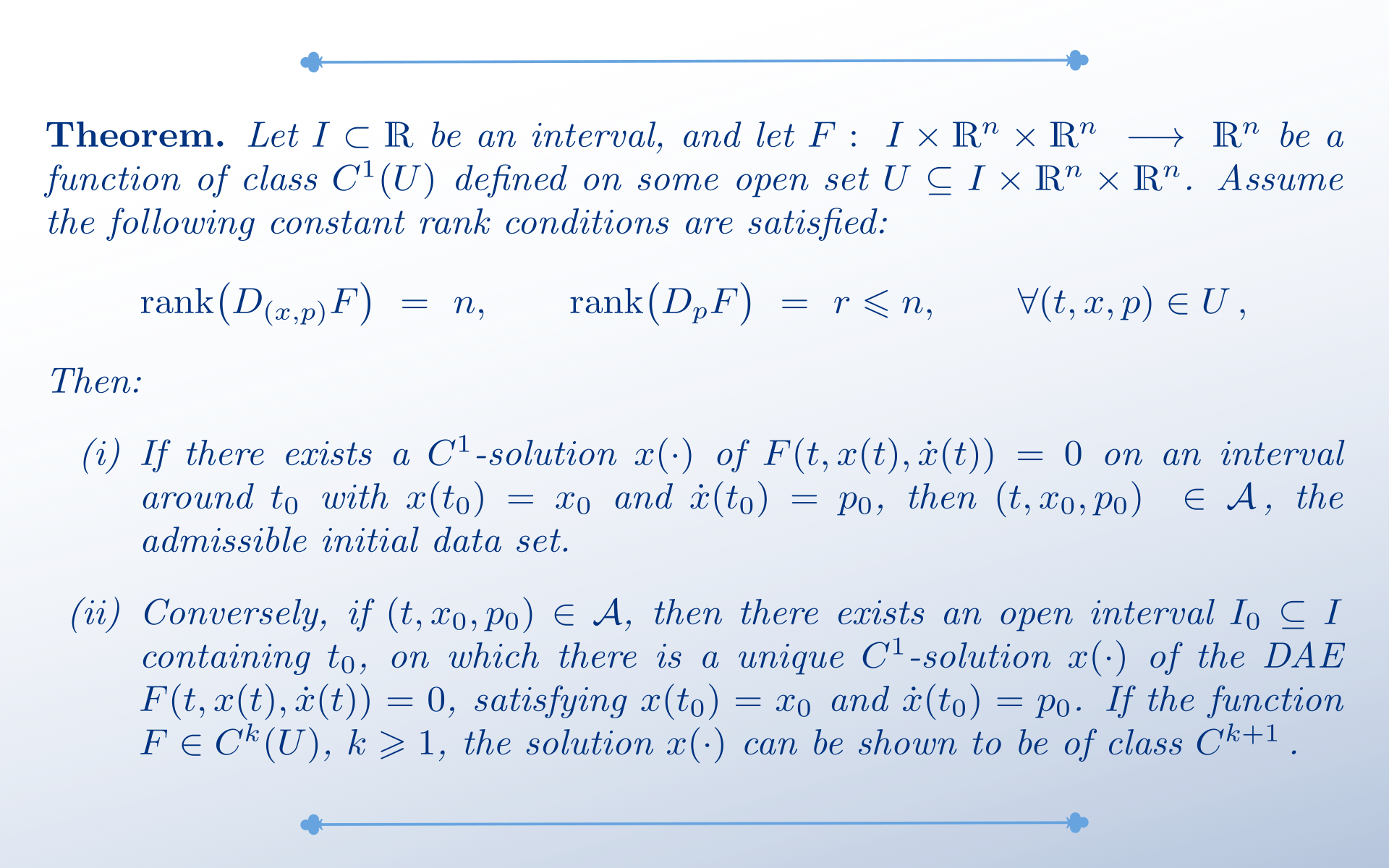
Dear Reader, the classical Cauchy-Lipschitz theorem is the central result in the theory of differential equations and is part of the standard Mathematical curriculum nowadays. By the way, in our Department, we regularly ask to formulate this Theorem during our PhD admission interviews. The question now is, what happens when the ODE is not solved with respect to the derivative? Such equations are called implicit ODEs. What if we add some algebraic constraints to it? Such equations are then called DAEs (Differential-Algebraic Equations). The question of the existence and unicity of solutions to such equations gets more complicated. The new notion of admissible initial conditions appears (I will put it under the carpet for the moment). The answer to these questions is given below:
Dr. Denys Dutykh
Associate Professor of Mathematics
Khalifa University of Science and Technology, Abu Dhabi, UAE
Related Posts
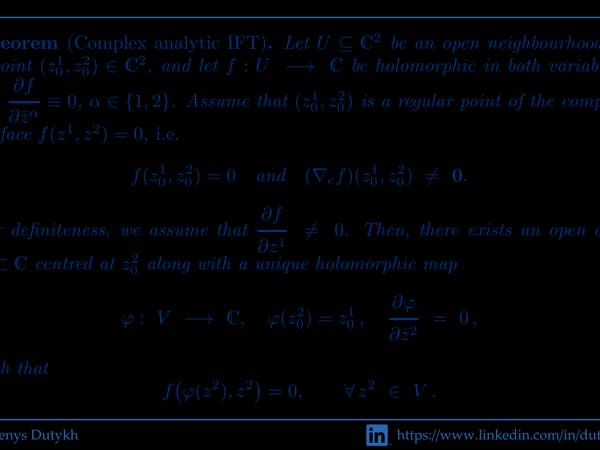
The Complex Analytic Implicit Function Theorem: A Brief Revisit
A concise look at the complex analytic version of the Implicit Function Theorem (IFT), focusing on the case of two complex variables and its generalization.

Osgood’s Uniqueness Theorem: Beyond the Lipschitz Condition
How far can the classical Lipschitz condition for uniqueness in ODEs be relaxed? Discover Osgood’s theorem and its historical context in the theory of ordinary differential equations.

Applied mathematics has met the machine before
The long version of my guest essay for Proofs and Prompts, published there on 28 September 2026.