
Osgood’s Uniqueness Theorem: Beyond the Lipschitz Condition
How far can the classical Lipschitz condition for uniqueness in ODEs be relaxed? Discover Osgood’s theorem and its historical context in the theory of ordinary differential equations.
The main result
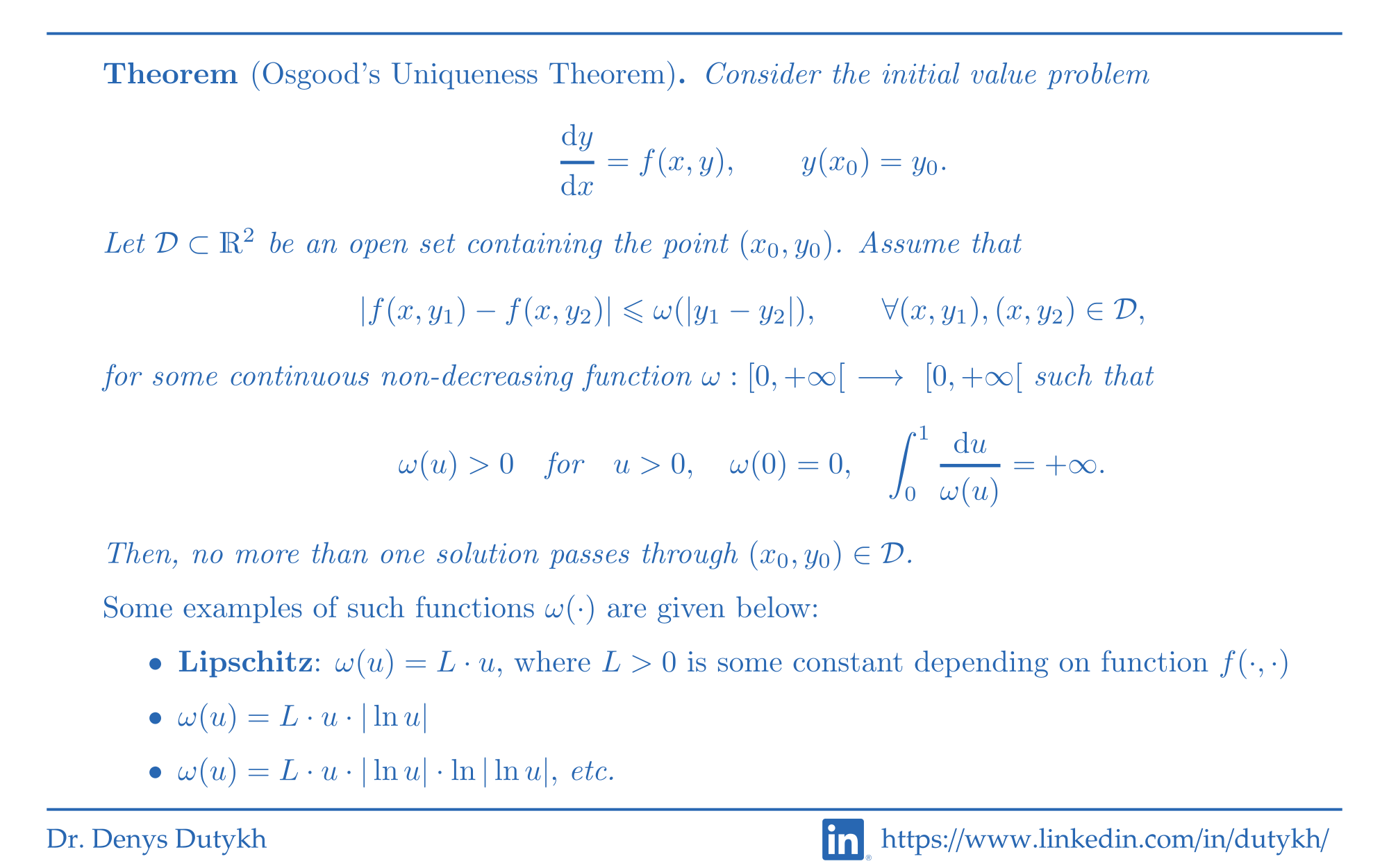
Today's brief will be another variation on the Cauchy-Lipschitz theme. However, we will take a different direction. Everyone who took a course in differential equations knows that the continuity of the right-hand side is enough for the existence, and the Lipschitz condition is needed to ensure the uniqueness. In this post, I would like to discuss to which limits the classical Lipschitz condition could be relaxed while keeping the unicity of solutions. The answer to this question was given at the very end of the XIXth century by an American Mathematician, Willian Fogg Osgood (1864-1943), who did his PhD under the supervision of Professor Felix Klein at the University of Göttingen, Germany.
Dr. Denys Dutykh
Associate Professor of Mathematics
Khalifa University of Science and Technology, Abu Dhabi, UAE
Related Posts
Cauchy-Lipschitz Theorem for Implicit ODEs: Existence and Uniqueness
Explore the Cauchy-Lipschitz (Picard-Lindelöf) theorem for implicit ordinary differential equations, which establishes rigorous conditions for existence and uniqueness of solutions in the general case.

Applied mathematics has met the machine before
The long version of my guest essay for Proofs and Prompts, published there on 28 September 2026.

Interim Guidance on the Use of AI Tools in Postgraduate Studies and Research
Interim guidance sent to the postgraduate students of our College on using AI tools in coursework, research and the thesis, written in the week of the Navier–Stokes announcement.