From Gauss–Lucas to de Bruijn–Springer
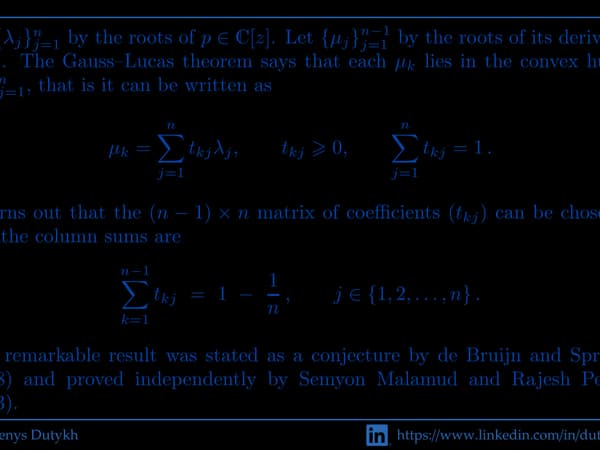
Gauss–Lucas puts the roots of the derivative inside the convex hull of the roots. De Bruijn and Springer conjectured in 1948 that they are pulled inward on average — it took 55 years and two proofs.
Tag
8 posts
Gauss–Lucas puts the roots of the derivative inside the convex hull of the roots. De Bruijn and Springer conjectured in 1948 that they are pulled inward on average — it took 55 years and two proofs.
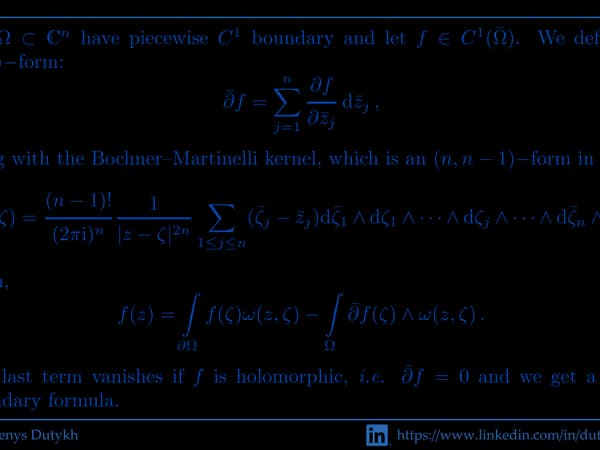
Closing the cycle on the Cauchy integral formula: Bochner–Martinelli recovers a function from its boundary data, up to a term measuring the failure of holomorphicity, with one universal kernel.
In several complex variables there is no translation-invariant holomorphic kernel. The Cauchy–Leray–Fantappiè formula answers this by building its kernel from a defining function of the boundary.
What survives of the Cauchy integral formula when the function is no longer analytical? A smooth version exists, and a single volume term measures exactly how far holomorphicity fails.
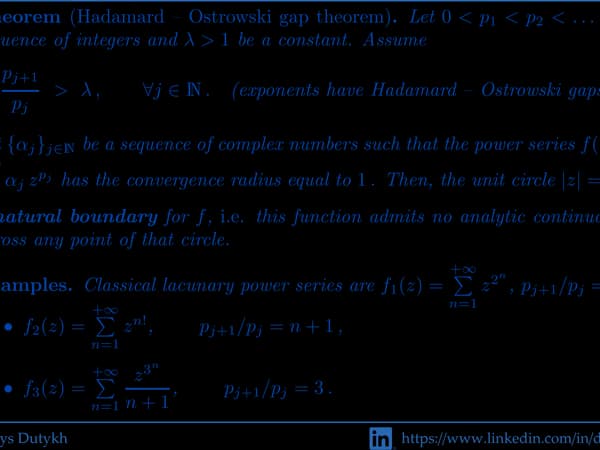
How do big gaps in power series relate to Stein manifolds? A look at the Hadamard Gap Theorem and why the unit disk is a Stein manifold.
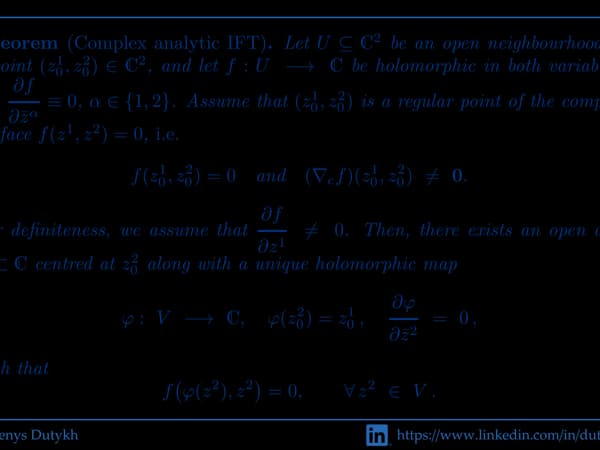
A concise look at the complex analytic version of the Implicit Function Theorem (IFT), focusing on the case of two complex variables and its generalization.
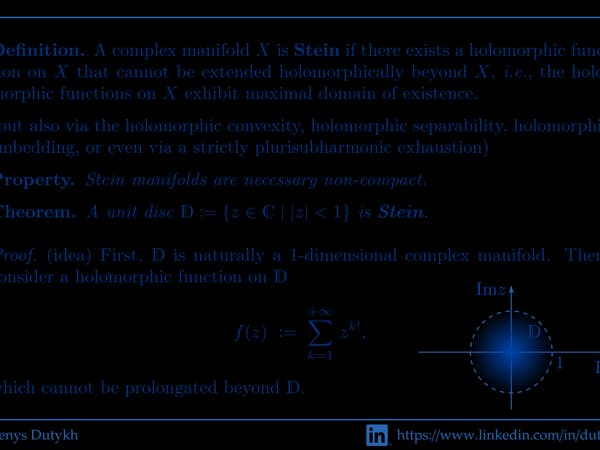
A brief introduction to Stein manifolds, their equivalent definitions, and the intuition behind domains of holomorphy in several complex variables.
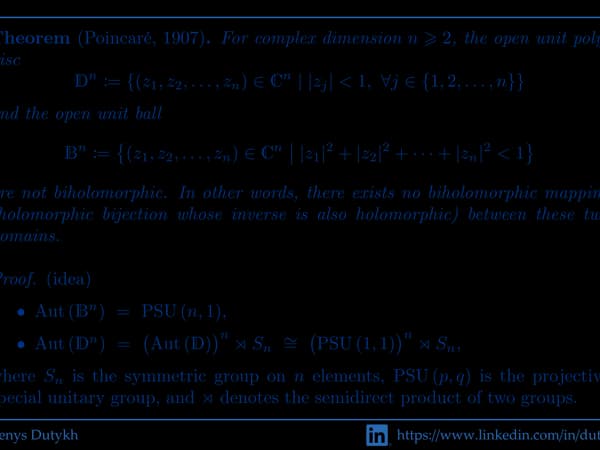
Why can’t we generalize conformal mappings to higher dimensions? Explore Poincaré’s theorem, which launched the study of several complex variables as a field of its own.